How to Interpret Your “Camel Calculator” Results?

- Published on
- Last updated
- Reading time
- 6 min read
Your camel score comes from the answers you gave: the looks and personality sliders count the most, while style picks and talent questions add small bumps on top. A high or low number just reflects your inputs, nothing real about you.
That's the quick read. Below is the full breakdown of what moves your number and why.
What Your Camel Score Is Actually Built From
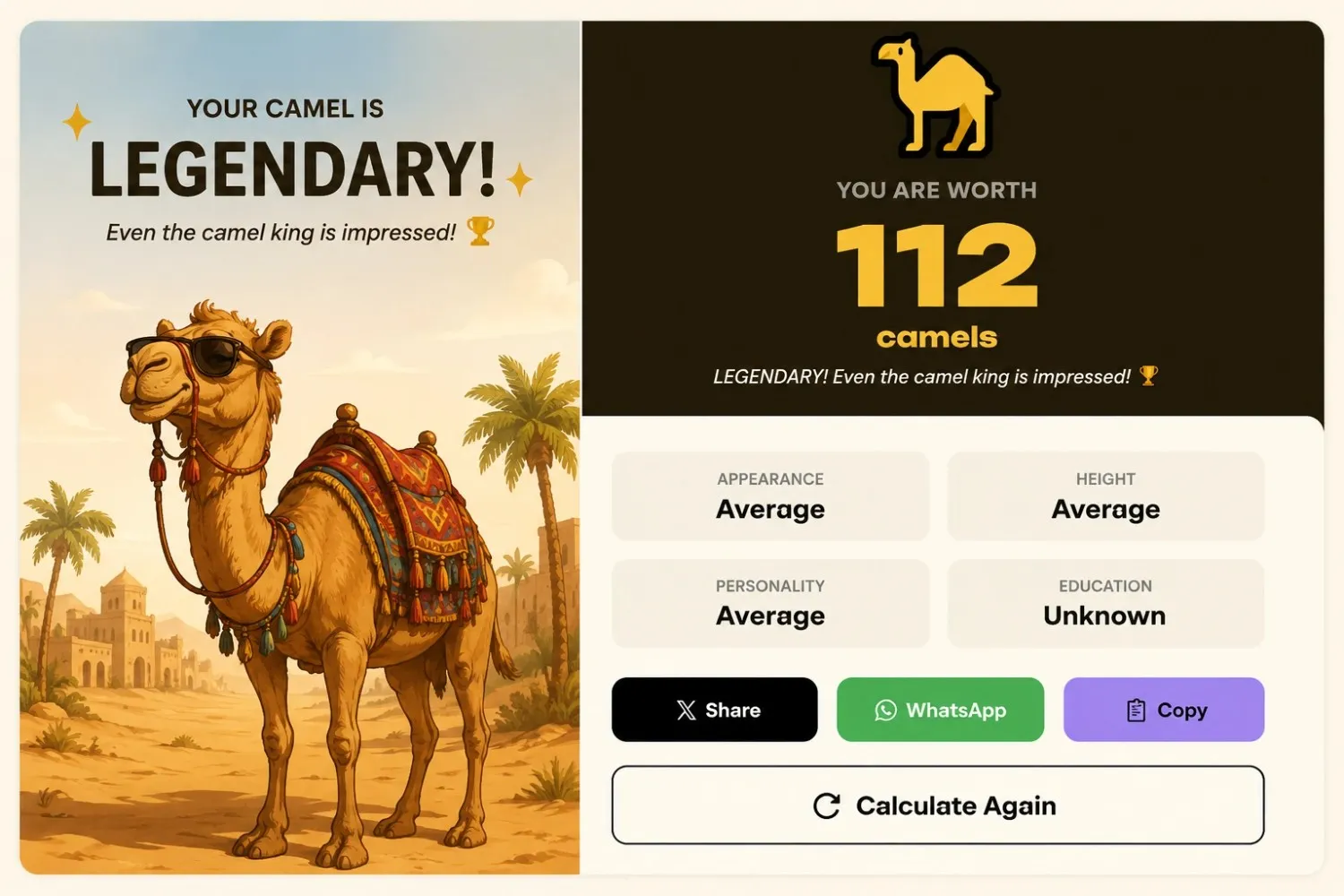
Your final number isn't pulled from thin air. It comes from the same handful of inputs you just gave us: your age, your looks slider, your personality slider, a few style picks, and a couple of yes-or-no questions about your talents. Each piece adds or trims a little from your total, and the result is the number you see on screen.
That's the whole trick. There's no hidden algorithm doing something mysterious in the background. It's a simple formula that takes what you told us and turns it into a score, the same way a recipe turns a list of ingredients into a dish.
Do the Quiz Scores of Men and Women Differ?
No. The formula doesn't run separate math for men and women. A slider moved to the same spot adds the same amount to your total regardless of who's answering, and the same goes for the style picks and talent questions. Gender isn't one of the inputs, so it isn't part of the calculation.
The “camel worth” joke itself has an older, lopsided history, where the value was traditionally tied to a bride rather than handed out evenly. Camel Calculator flips that on its head. Anyone can run the quiz, anyone can get a high or low number, and anyone can pass their result to a partner, friend, or sibling, regardless of gender. It's the same playful joke, just open to whoever wants to take it.
Breaking Down the Pieces
Your Sliders Carry the Most Weight
The looks and personality sliders move your score more than anything else on the quiz. Slide them higher, and your number climbs with them. They're the biggest dial you're turning, so if your score feels low, this is usually where to look first.
Style Picks Add Small Bumps
The quick style questions don't swing your score wildly, but they do nudge it. Think of these as seasoning rather than the main ingredient. A confident answer here might earn you a point or two, nothing more dramatic than that.
Talent Questions Are the Wildcard
The yes-or-no talent questions are where a little personality sneaks into the math. Answer yes to enough of them, and you'll see a small jump. Answer no across the board, and your score levels out closer to your slider baseline.
Why Your Score Can Feel Weirdly Accurate
Here's something funny that happens with almost every quiz like this: people read their result and think, “Okay, that's actually kind of me.” That reaction has a name, and psychologists have studied it closely as a well-documented psychological pattern called the Barnum Effect, which explains why vague, generally flattering descriptions feel personal even when they'd apply to almost anyone.
Your camel score works the same way. A high number feels like confirmation. A low one feels like a roast aimed straight at you. In reality, it's just math reacting to a handful of sliders you moved a few seconds earlier. The same instinct is part of why the old camel-trading joke this whole quiz is built on caught on in the first place: people love seeing themselves in a number, even a silly one.
What a High Score Actually Means
A big number is fun to share, but it isn't a verdict on anything. It mostly means your sliders sat on the higher end, and a few of your other answers lined up the same way. Enjoy the bragging rights for the length of a group chat conversation, and then let it go. It's a quiz result, not a personality profile.
What a Low Score Actually Means
A smaller number can sting for about ten seconds, and then it shouldn't matter at all. It just means your inputs landed lower this round. Run the quiz again with your sliders nudged up, or different style picks, and you'll likely see a different number. That's the nature of a formula built for laughs, not for precision. We say as much, plainly, on the page where we lay out why none of this should be taken to heart.

Tips for a Higher Score
Since the formula runs on the answers you give it, there's no secret trick here, just a few things worth knowing before you tap through again.
- 1Push your sliders, don't park them in the middle.The looks and personality sliders carry the most weight, so a confident slide to the right does more for your score than a cautious tap near the center.
- 2Don't skip the talent questions.A “no” across the board keeps your score sitting at its baseline. Answering yes where it's true adds a small bump each time.
- 3Pick the boldest style option that still feels like you.These picks add smaller bumps on their own, but they stack with everything else.
- 4Retake it once you've seen your breakdown.Now that you know which category moves the needle most, your second run usually lands closer to where you want it.
None of this changes the joke at the heart of the quiz. It just means you're answering with a bit more intent instead of clicking through on autopilot.
What to Do With Your Result
Once you've got your number, there's not much homework left. Screenshot it, send it to whoever you compared notes with, and see how their breakdown stacks up against yours. If your score didn't land where you expected, run the quiz again and watch which slider or pick moves the needle the most. That's honestly half the fun of it.

A Final Word
Your camel score is a snapshot of a few quick answers, nothing deeper than that. Read the breakdown, laugh, and move on with your day. If you take anything from this page, let it be this: the number changes, the joke doesn't, and that's exactly how it's supposed to work.
Frequently Asked Questions
Why did my camel score change when I took the quiz again?
Because your answers changed, even slightly. Move a slider a few points, pick a different style option, or switch one yes-or-no answer, and the total shifts with it. That's expected, not a glitch.
Does a low camel score mean something is wrong with my answers?
No. It just means your inputs landed on the lower end of the formula this time. There's no “wrong” way to answer the quiz, since it isn't grading you on anything real.
Which questions affect my score the most?
The looks and personality sliders move your total the most. The style picks and talent questions add smaller adjustments on top of that.
Can my score go above the highest number I've seen friends get?
Sure, scores depend entirely on your own answers, so there's no cap tied to what anyone else got. Push your sliders up and answer the talent questions with a yes, and you'll likely see your number climb.
Should I take my camel score seriously?
Not even a little. It's built for laughs, with zero science behind it. Treat it like a fortune cookie message, not feedback on who you are.